
Announcing Iceberg Backups: Cost-Efficient, Point-in-Time Table Recovery
Today we are introducing something we are really excited about - Iceberg Backups: a new way to manage snapshots that gives you reliable recovery points, predictable costs, and zero manual overhead.
Apache Iceberg snapshots enable time travel, rollback, and table history tracking. But you can't keep snapshots forever, which forces most teams into an uncomfortable tradeoff: recovery capability vs. storage costs.
The default approach of "keep snapshots for N days, delete everything else" leaves you with no real recovery options. Batch ingestion accumulates snapshots within days. Streaming workloads accumulate them within hours. Either way, you're forced to choose between expensive snapshot bloat or losing the ability to recover historical data.
Ryft's new Snapshot Lifecycle policies solve this. You get intelligent snapshot management, predictable costs, and reliable recovery points, without manual tuning.
Snapshots Are Hard to Manage
Most teams default to naive expiration: keep snapshots newer than N days, expire everything older.
This creates three problems:
- Lost recovery capability - A table with hundreds of daily snapshots loses all historical context beyond the retention window. Need to recover last month's data state? Too late.
- Costs scale with write frequency, not business need - High-frequency tables (streaming, CDC, etc) generate thousands of snapshots. Keeping them all is financially unsustainable; deleting them all is operationally risky.
- Manual management doesn't scale - Tuning retention policies table-by-table across thousands of tables is a full-time job nobody wants.
What teams actually need is a smarter approach: structured recovery points that provide meaningful restore capability without unbounded storage growth.
The Solution: Intelligent Snapshot Lifecycle Policies
Ryft's Snapshot Lifecycle brings database-style backup strategies to Iceberg. Instead of keeping all snapshots or deleting them blindly, you define intelligent retention rules, for example:
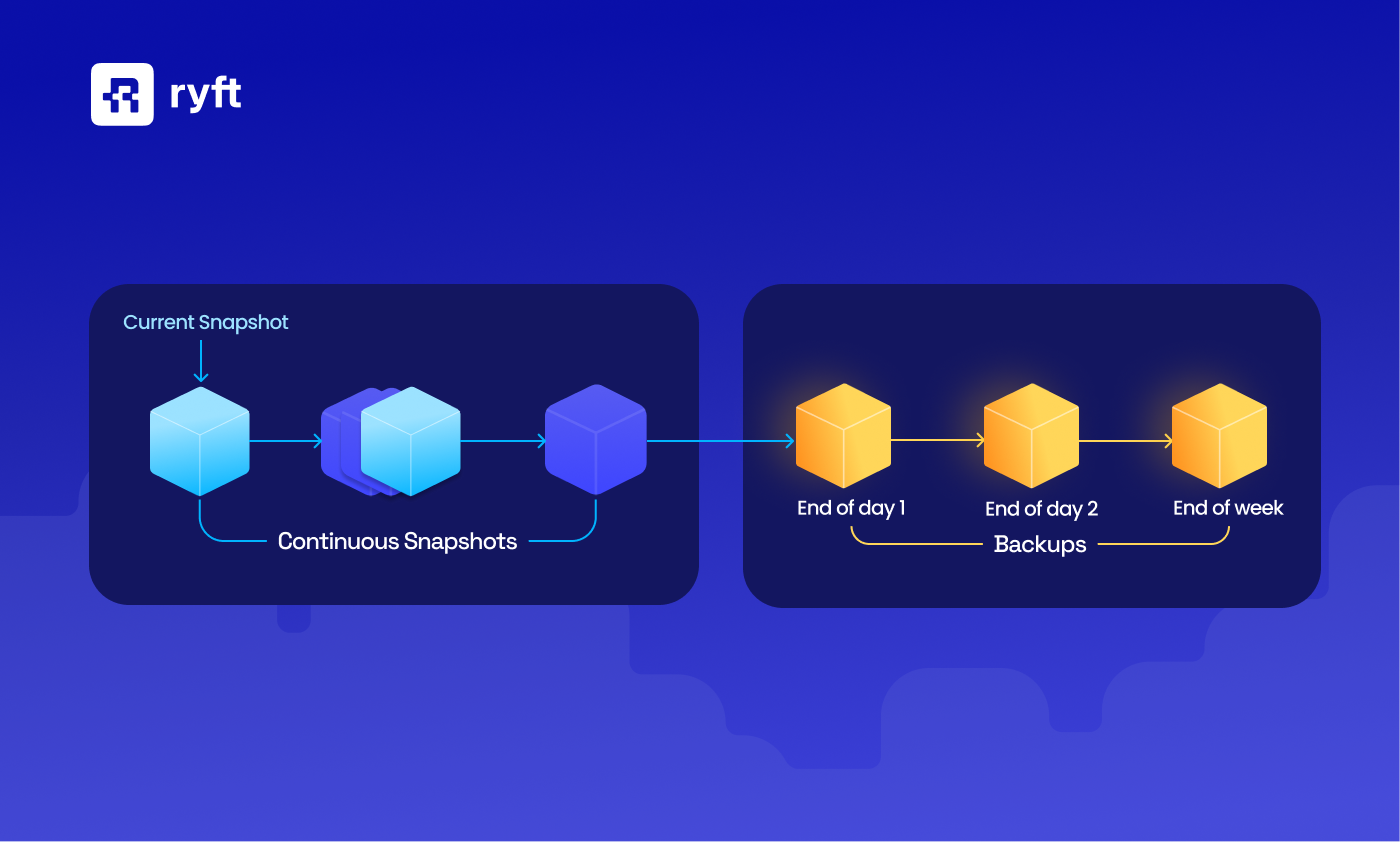
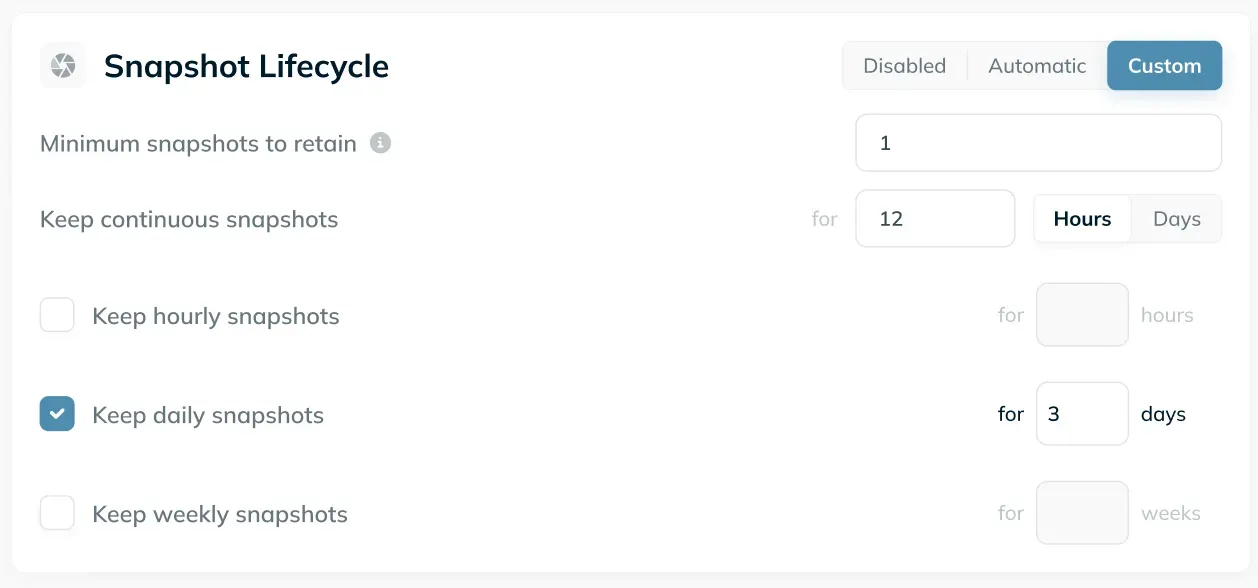
Keep 12 hours of real-time snapshots for fast debugging, plus the last snapshot of each calendar day for 7 days. Expire everything else automatically.
This gives you:
- Recent snapshots - Full resolution for fast iteration and debugging
- Daily recovery points - One reliable snapshot per day for historical recovery
- Automatic cleanup - Everything beyond your threshold expires without manual intervention
The Result
1. Simpler Snapshot Management
Snapshot Lifecycle policies apply calendar-aware retention logic across all your tables including high-frequency streaming, CDC and more. No more manual scripts or per-table tuning.
2. Predictable, Lower Costs
Naive retention is expensive. Keeping every snapshot from high-frequency tables burns through storage budgets fast.
With Snapshot Lifecycle, storage costs scale with days retained, not write frequency. You keep the recovery points that matter and stop paying for the ones that don't.
3. Safer Table Recovery
Most teams discover their retention policy failed them at the worst possible moment, when they actually need to recover data.
Snapshot Lifecycle guarantees meaningful recovery points exist. Every day, you have a reliable snapshot you can restore to.
How It Works in Ryft
Snapshot Lifecycle is fully integrated into the Ryft platform. Configure your retention policy, assign it to tables or apply it lakehouse-wide, and let Ryft handle execution.
What you get:
- Calendar-aware retention - Automatically identifies and preserves the last snapshot of each day or week
- Real-time snapshot access - Keeps all recent snapshots for fast debugging and iteration
- Bounded metadata growth - Snapshot count grows predictably with your retention window
- Native Iceberg integration - Uses standard Iceberg tags, compatible with any query engine in your stack
Safe Snapshot Restoration
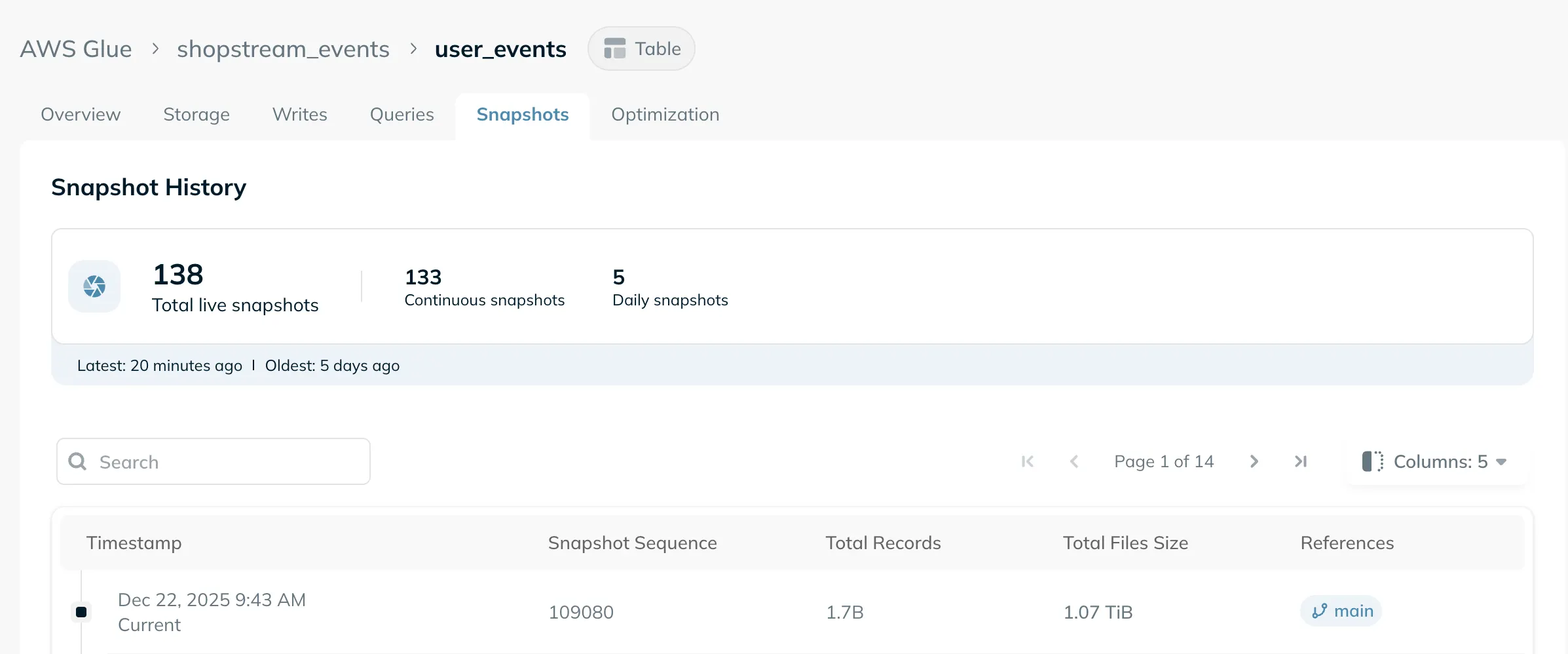
We're also releasing a new experience to view and restore snapshots. See all tagged recovery points on any table, whether created by Snapshot Lifecycle or manually, and restore to that point in time with a single action.
Wrapping Up
Managing Iceberg snapshots manually is tedious and expensive, and most teams compromise having meaningful point-in-time recovery options.
Snapshot Lifecycle policies give you a better path: intelligent retention that preserves meaningful recovery points, controls costs, and eliminates manual overhead.
Our customers are already seeing improvements of more than 60% in storage costs in production, while having much longer recovery periods.
This is how Iceberg table recovery should work.
Ready to add automated backups to your lakehouse? See Ryft in action
Browse other blogs
Announcing the Ryft Context Layer
Ryft already monitors Iceberg lakehouses for optimization and observability. That means we already collect the signals that matter most for context: schema and structure, query patterns across every engine (Spark, Trino, Snowflake, Athena), write and ingestion behavior, freshness, and statistics. It's the same information a senior analyst would use to understand a table, captured in real time, at infrastructure scale.The Lakehouse Context Layer combines these signals into rich, agent-readable context for every table. Instead of starting from a blank documentation page, your tables come with context that reflects how the data actually behaves: what gets queried, how it's joined, how often it's updated, what the common access patterns look like.
.avif)
.avif)
.avif)